LEADERSHIP RESEARCH & EXECUTIVE ADVISORY
LEADERSHIP.
AUTHORITY.
RESPONSIBILITY.
Dr. Marisol Capellan is a leadership scholar-practitioner, author, researcher, and executive advisor examining how organizations distribute and exercise authority, opportunity, voice, and responsibility.
Her work explores leadership as both an individual practice and an organizational system of power, judgment, accountability, and consequences.
Author of Leadership Is a Responsibility · TEDx Speaker · Ed.D. · Founder, The Capellan Institute

THE CENTRAL QUESTION
Leadership is not merely about developing better individual leaders.
Leadership is about how organizations distribute the conditions through which leadership becomes possible-and consequential.
AUTHORITY
OPPORTUNITY
VOICE
RESPONSIBILITY
POWER
CONSEQUENCES
THE INTELLECTUAL PROGRAM
Four questions organize the work.
Leadership becomes clearer when we examine not only who leads, but how responsibility, authority, opportunity, voice, and judgment are distributed through organizations.
01
LEADERSHIP & RESPONSIBILITY
What do leaders owe the people and systems affected by their power?
Leadership creates responsibility for decisions, cultures, opportunities, systems, and consequences that extend beyond the leader.
02
WOMEN, POWER & LEADERSHIP
Representation is not authority.
Who is visible in leadership matters. But representation alone does not tell us who receives sponsorship, discretion, influence, legitimacy, or consequential authority.
03
VOICE & ORGANIZATIONAL JUSTICE
Inclusion without voice is incomplete.
Organizational inclusion is limited when people are present but cannot safely influence decisions, challenge authority, or shape the systems that affect them.
04
FUTURE OF LEADERSHIP
What must remain human?
Technology can change who acts, recommends, predicts, or decides. It does not eliminate leadership responsibility for judgment, accountability, legitimacy, and consequences.
FOUNDATIONAL WORK
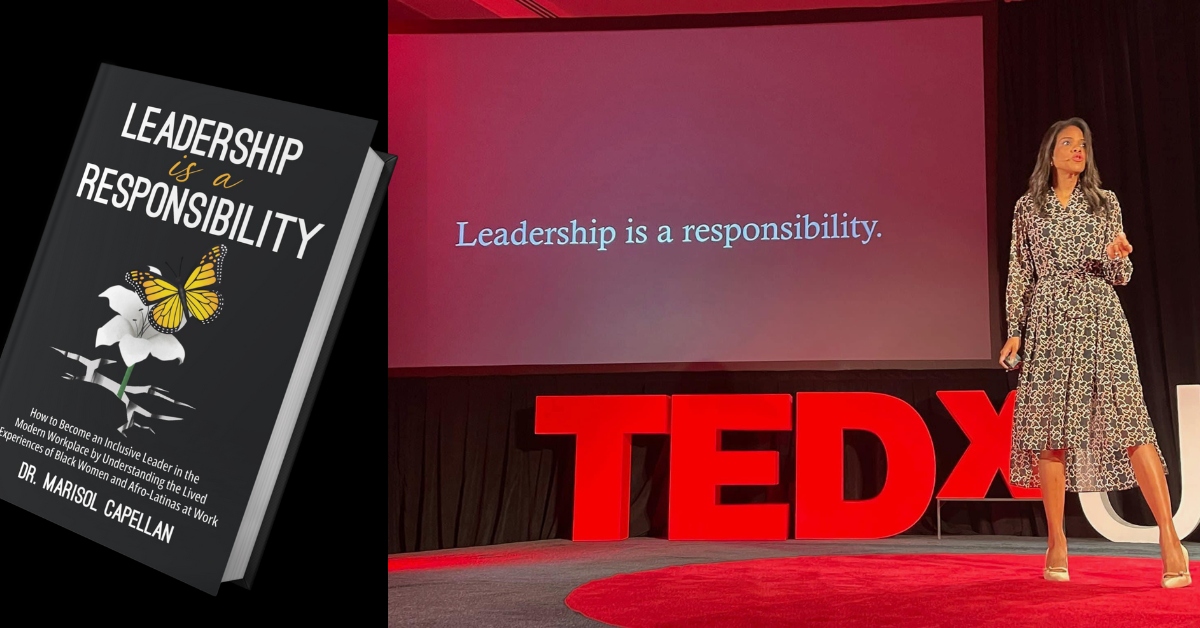
Leadership is a Responsibility
The foundational book established the responsibility thesis that now underlies Dr. Capellan’s evolving work on authority, opportunity, voice, organizational systems, and human judgment.
CURRENT RESEARCH
Five research streams are shaping the next phase of the work.
Dr. Capellan’s current research examines how authority is acquired, exercised, experienced, challenged, and held accountable across contemporary organizations. Also, how people gain access to consequential influence, whose information is capable of shaping decisions, and what happens to human judgment and responsibility as leadership becomes increasingly mediated by technology.
The agenda connects leadership research with questions of power, legitimacy, voice, organizational justice, managerial judgment, and emerging technologies. The streams are connected by a common concern: leadership cannot be understood only through individual traits or competencies. It must also be examined through the organizational systems that determine who has authority, who receives opportunity, whose voice carries weight, and who remains responsible for consequential outcomes.
01
Responsible Authority™
An emerging research program examining the relationship among authority, discretion, judgment, accountability, legitimacy, and consequences. The current work tests whether this territory is already explained adequately by existing scholarship or whether a theoretically distinct contribution remains.
02
The Authority Gap
This research examines whether formal leadership representation necessarily produces comparable substantive authority. It considers how sponsorship, strategic access, discretion, credibility, opportunity, and organizational legitimacy may shape the authority leaders are actually able to exercise.
03
Who Gets Heard?
This stream examines the organizational process between employee expression and meaningful influence. The research asks how status, credibility, managerial responsiveness, organizational justice, and decision authority affect whether information raised by employees receives consequential consideration.
04
Human Authority at Work
As artificial intelligence becomes more influential in organizational decision-making, this research examines what happens to human managerial authority, judgment, legitimacy, and responsibility. A central question is whether formal human oversight remains meaningful when practical decision influence increasingly shifts toward technological systems.
05
Responsibility-Centered Leadership
This developing research direction asks whether responsibility for the consequences of authority can be distinguished meaningfully from existing leadership constructs. The work begins with construct comparison rather than assuming that a new theory is required.
Follow the research as it develops.
The research program is being developed through literature review, construct comparison, working papers, empirical design, scholarly collaboration, and eventual original data collection.
EMERGING RESEARCH PROGRAM
Responsible Authority™
Responsible Authority™ is Dr. Marisol Capellan’s emerging research program examining what happens when people and institutions possess consequential authority over others—and what responsibility should accompany discretion, judgment, power, and decision-making.
The work investigates the relationship among authority, accountability, legitimacy, organizational systems, and consequences. It also asks whether the phenomenon requires a distinct theoretical construct or is better explained through relationships among existing scholarship on responsible leadership, ethical leadership, managerial discretion, organizational justice, stewardship, and related fields.
01 — AUTHORITY
Who has the power to decide?
Formal titles reveal only part of organizational authority. The research examines decision rights, practical discretion, resource control, influence, and the capacity to alter consequential outcomes.
02 — JUDGMENT
How is discretion exercised?
Authority becomes consequential through judgment. Leaders interpret incomplete information, choose among competing interests, determine when exceptions are warranted, and decide which consequences deserve attention.
03 — RESPONSIBILITY
What obligations follow from that power?
Responsibility concerns what authority holders should recognize, consider, prevent, address, explain, and ultimately own because of the consequences their decisions can create for others.
04 — LEGITIMACY
Why should others accept the exercise of authority?
Organizational authority depends not only on formal position but also on whether people perceive its exercise as credible, fair, explainable, and appropriately connected to responsibility.
The concept is emerging. The scholarship comes first.
Responsible Authority™ should not be presented as a validated theory simply because the name is compelling. The current research is testing the idea against established scholarship and examining whether its apparent contribution is truly distinct, integrative, relational, or better represented through existing constructs.
The objective is not to protect the terminology. It is to identify the most defensible explanation of the phenomenon.
Why the question becomes more urgent in the AI era?
Artificial intelligence is making the distribution of authority more complex. Technological systems increasingly recommend, rank, predict, evaluate, and influence decisions while human managers often remain formally responsible for the outcomes. This creates new questions about meaningful human control, managerial legitimacy, override authority, and who remains responsible when judgment is distributed between people and systems.
The Capellan Institute
Where leadership research and experience becomes organizational practice.
The Capellan Institute is the applied arm of Dr. Marisol Capellan’s work, translating research and intellectual frameworks into executive advisory, leadership development, organizational diagnostics, enterprise learning, and practical tools for leaders and institutions.
Its work focuses on the organizational consequences of leadership: how authority is exercised, how opportunity is distributed, how employee voice is received, how responsibility is assigned, and how leadership systems can be strengthened when human judgment carries meaningful consequences.
The Institute provides a bridge between scholarship and implementation. Research developed through Dr. Capellan’s broader intellectual program can be translated into executive education, organizational assessment, leadership development, research partnerships, and tools designed for practical use inside organizations.
The research asks what leadership should become. The Institute helps organizations put those ideas to work.